Saturday, March 24, 2012

EU committed to support Lao UXO sector

The European Union is committed to further support unexploded ordnance (UXO) clearance in Laos and enable the rural poor to improve their livelihoods.
Speaking during an interview with Lao media earlier this week while on a visit to an EU-funded UXO project in Savannakhet province, ChargĂ© d’Affaires of the EU Delegation to Laos Mr Michel Goffin said “The EU has been here for 14 years with Handicap International and other NGOs. We’re investing a lot of money and we will invest even more next year.”
Mr Goffin explained why the EU is engaging in UXO clearance outside of Europe. “The EU has been the location of many terrible wars and this is the first justification for us to be active and remove the traces of war outside Europe…we want to support the banning of cluster munitions and UXO clearance.”
He said other countries have only eight Millennium Development Goals (MDGs) but Laos has another one related to UXO clearance. He pointed out that the obligation to remove UXO in Laos is not just the responsibility of Laos but of donor countries.
The EU not only aims to support UXO clearance but also to provide adequate capacity to the Lao government so that it is self-sufficient in terms of UXO clearance.
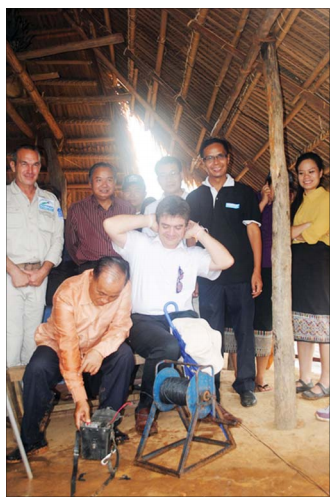
Lao Minister to the Government Office and President of the Leading Committee for Rural Development and Poverty Eradication, Mr Bounheuang Duangphachanh, also joined the trip to view the EU-funded UXO project implemented by Handicap International in 40 villages of Sepon, Nong and Vilabouly districts in Savannakhet province.
The main purpose of the visit was to see the progress, achievements and approaches used by Handicap International in their efforts to return residential and farming areas back to local communities.
Mr Bounheuang reiterated that UXO is one of the main causes of poverty in Laos.
“In recent years, we have cleared more than 30,000 hectares of UXO and detonated more than one million bombs in Laos but there are still many more bombs remaining throughout our country,” he said.
“Wherever we go, we will see only bombs. Lao people live under the threat of UXO. Every year, about 300 fatalities are reported and many of them are children.”
The minister called for the international community to provide more support for UXO clearance to help poor people in rural areas to expand their farmland and increase productivity.
The EU is one of the major donors to the UXO sector in Laos and works closely with national and international bodies to help the country reduce the UXO risk and alleviate poverty by providing financial assistance to implementing agencies. The EU supports Handicap International, the Mines Advisory Group (MAG), Lao National Regulatory Authority and Lao National UXO Programme.
Over the last decade, EU assistance to the UXO sector in Laos amounts to over 10 million euros, of which about 6.7 million euros has been provided through Handicap International for activities aiming at reducing UXO impact and victim assistance.
The EU recently approved a new financial contribution of 4 million euros, of which 2.6 million euros will be provided through a Call for Proposals and 1.3 million euros through a UXO Trust Fund managed by the United Nations Development Programme.
Source: Vientiane Times
By Somsack Pongkhao
(Latest Update March 24, 2012)

Wednesday, February 29, 2012

UXO DETECTION EQUIPMENT TEST SITE TO SET STANDARD IN LAOS

The unexploded ordnance (UXO) detection equipment company Mine Lab yesterday introduced a detector testing site in Vientiane, which they hope will set a standard for all UXO detectors to be used in Laos.
The testing site is supported by the Lao Union of Science and Engineering Associations and the Minerals and Metals Group UXO Department. Detection equipment was tested at Lao Techno Engineering with the help of expert Mr Douglas A. Handisides.
The test unit is quite easily replicated. Its design has not been patented, meaning it is public knowledge and can be used freely.
Mr Handisides said “We have done much research over the last four years and we came to feel the need for a standard testing block that detectors must pass before being used in Laos. For this reason we have constructed a test area made up of a completely metal free concrete block structure divided into five compartments, and covered in a layer of concrete about 20mm thick.”
The testing unit is made up of several compartments containing different types of soils found in Laos. They include sand, non-magnetic soil, and soil that contains magnetic mineral deposits.
The idea is to design a universal detector that can cover all soils found throughout Laos. This would save money and speed up clearance, and would also reduce human error when using different detector types and working in different provinces.
Mr Douglas added that checking many detector brands on this test area has come up with some interesting results. Some detectors can detect bomblets, but cannot detect 40mm shells, as the shells are aluminium.
Laos is the most heavily bombed country in the world per capita.
Remaining UXO is stalling development in many rural areas and preventing commercial investments in many sectors.
Due to the high amount of UXO in the country, Laos should be setting the global standard for detection equipment rather than accepting what is currently on the market, Mr Handisides said.
Laos should be pushing manufacturing companies to develop a detector that achieves safety and speed requirements with as little impact as possible on the ecosystem and soil microorganisms, he suggested.
The new testing area has the potential to set a global standard for detectors, he said.
Source: Vientiane Times
By Khonesavanh Latsaphao
(Latest Update February 29, 2012)

Friday, February 24, 2012

Norway, US fund UXO clearance in southern provinces : Lao Voices

Norway and the United States yesterday contributed US$20 million towards an unexploded ordnance (UXO) survey and clearance project in Saravan, Xekong and Attapeu provinces.
The National Regulatory Authority (NRA) signed a memorandum of understanding with the Norwegian People’s Aid (NPA) in Vientiane on February 23.
The project’s budget for the five-year period from 2012-2016 has been provided by the Norwegian Ministry of Foreign Affairs and US State Department, NRA Director Mr Phoukhieo Chanthasomboun said at the signing ceremony.
“This project is very important in order to address the various issues posed by UXO,” he said.
Mr Phoukhieo said the project will help Lao people of all ethnicities in the three provinces to lead lives free from the dangers posed by UXO in line with the government’s National Socio-economic Development Plan, enabling them to expand their agricultural production and lift themselves from poverty.
The NPA is an international, non-governmental organisation based in Oslo, Norway, which has worked in Laos for humanitarian mine action since 1997.
Over the years, the NPA has provided strong support to UXO/Mine Action Sector work in Laos, helping to introduce new technology into the country’s efforts.
Mr Phoukhieo expressed his gratitude to the NPA for conducting UXO survey and clearance work in Saravan, Xekong and Attapeu provinces from 2007-2010.
Following the signing of the Memorandum of Understanding, the NRA will continue to work with the NPA to coordinate with the government from the central to grassroots level to ensure UXO survey and clearance work runs smoothly.
The Lao government is highly appreciative of both the Norwegian and US governments and also thanks the NPA for responsibly implementing this project, he said.
The NPA considers its Lao project one of the most important in its portfolio of countries.
“We work in more than 20 countries, clearing landmines, cluster munitions and other devices, but in many ways Laos is the most important,” NPA Director Mr Atle Karlsen said, pointing to the estimated size of the problem and Laos’ brave and exemplary leadership regarding the Convention on Cluster Munitions.
In September 2010, the NPA developed an approach called Land Release Survey, aiming to solve the problem in Laos. In the year and a half since, it has refined and tested this approach, which has shown great results, Mr Karlsen said.
The approach involves a range of survey principles, both non-technical and technical, adapted to the Lao context, he said, adding that it will establish a very real estimation of the remaining problem when it comes to cluster munitions.
M r Karlsen said he is happy that the NRA is adapting the national standard for surveying and greatly hopes that this approach and similar ones will assist in making a real impact on the ground over the next five years.
“We will expand and almost double our operations this year for the benefit of the sector in general and Saravan, Xekong and Attapeu provinces in particular,” he said.
Source: Vientiane Times
By Khonesavanh Latsaphao
(Latest Update February 24, 2012)

Thursday, February 2, 2012

DEPUTY PM CALLS FOR MORE DETAILED REGISTER OF UXO VICTIMS


Deputy Prime Minister Mr Asang Laoly yesterday called on the Lao National Regulatory Authority (NRA) committee to work harder to establish a more detailed register of unexploded ordnance (UXO) victims nationwide.

Mr Asang Laoly ( left ) and Minister to the Government Office Mr Bounheuang Duangphachanh attend the meeting.
Speaking at the NRA’s annual meeting at the Government Office in Vientiane, Mr Asang said data is available regarding the number of UXO victims and survivors since the Indochina War ended in 1975.
However, he said the information needs to be more specific. “There are more than 20,000 UXO survivors in the country, but we want the NRA committee to make clearer distinctions so that we know, for example, how many had to undergo amputations and how many were blinded, as well as their vocational status.”
As chairman of the meeting, Mr Asang congratulated NRA committee members on their UXO clearance work and victim assistance.
He also advised the committee to build a UXO museum to help future generations better understand the efforts of the Lao people in fighting foreign aggressors during the Indochina War.
“Many Lao people born after the 1970s have little knowledge of the Lao fighters who sacrificed their lives to protect the country during the war,” the deputy PM said.
Speaking at the opening of the meeting, NRA Consultant Mr Maliya Sayavong suggested that the authority build more dispensaries in UXO-contaminated areas to help people who fall victim to explosions.
He said the NRA needs to source more funding from international donors in order to open more dispensaries around the country.
Meanwhile, the government is looking to clear about 20,000 hectares of UXO-contaminated land each year.
Deputy Minister of Foreign Affairs Mr Alounkeo Kittikhoun said this target is achievable if the government continues to seek new clearance methods.
He cited the Japan Mine Action Service’s use of a Komatsu UXO clearance vehicle for a five-month pilot project in Xieng Khuang province, beginning from January 2, as one such innovation.
“This vehicle takes one hour to clear one hectare of all cluster bombs,” Mr Alounkeo said.
“At present, the Lao National UXO Programme (UXO Lao) employs 22 people to clear one hectare per month, with a clearance capacity of 5,000 hectares per year.”
Until now, almost 30,000 hectares of UXO-contaminated land have been cleared since 1996.
Source: Vientiane Times
By Khonesavanh Latsaphao
(Latest Update February 02, 2012)

Tuesday, January 24, 2012

Laos aiming to speed up UXO clearance

The National Regulatory Authority (NRA) and Lao National Unexploded Programme (UXO Lao) held an annual project review and UXO Trust Fund steering committee meeting in Vientiane yesterday to discuss ways of speeding up UXO clearance.

Speaking at the opening of the meeting, Deputy Minister of Foreign Affairs Mr Alounkeo Kittikhoun said it is currently possible to clear about four or five thousand hectares of land per year, destroying more than 62,000 unexploded bombs in the process.


“If our clearance capacity reached 5,000 ha per year, we would be able to clear around 50,000 ha in 10 years, but really we need to find ways of finishing upwards of 200,000 hectares over this period,” he said.

“We have invited all staff from the NRA, UXO Lao and donors to this meeting to see if we can identify new ways to speed up UXO clearance in Laos,” Mr Alounkeo said.

He added that if no breakthroughs are to be found, clearance work could take hundreds of years.
“The speed of UXO clearance is dependent on the methods used,” the deputy minister said.
NRA Director Mr Phoukieo Chanthasomboun said 2011 posed several challenges for the authority, but many UXO survivors made great strides with their rehabilitation, including finding meaningful employment.

“However, of the more than 20,000 UXO survivors in the country, only 3,023 have received our help,” he pointed out.

Mr Phoukieo said that in 2011 the NRA was able to track down 92 new UXO accident survivors, but added that this figure was most likely inaccurate due to the difficulty of reporting all incidents.
He said most accident survivors are in need of vocational training and financial support to improve their livelihoods as they come from very poor families.

The NRA’s operations are key to ensuring the implementation of Millennium Development Goal (MDG) 9 to reduce the impact of UXO in Laos in accordance with the National Strategic Plan for the UXO sector known as ‘The Safe Path Forward II’.

This MDG should further function as a multiplier to MDGs 1-7 by providing increased access to assets and services for improved livelihoods.

More than 28,000 hectares of UXO-contaminated land have been cleared since 1996. By 2020 it is hoped that UXO will have been cleared from 200,000 hectares of land.

Source: Vientiane Times
By Khonesavanh Latsaphao
(Latest Update January 24, 2012)

Tuesday, January 17, 2012

Borikhamxay bomb detonated


Solidarity Service International (SODI) bomb disposal experts have successfully detonated the 2,000 pound bomb recently unearthed by a road worker in Khamkeuth district, Borikhamxay province. 

Mr Pounsawath Thavisouk, a member of the SODI UXO clearance team, said they disarmed the bomb in a controlled detonation on Sunday. He told local media on Monday that “a temple, a primary school and a few homes were damaged”. 

The clearance team initially decided to wait for two weeks before attempting to remove, defuse or detonate the bomb due to concerns about the automatic timing mechanism, so they buried it underneath 4,000 sandbags and evacuated Oudom village. 

In the end they decided to conduct a controlled demolition onsite as it was deemed too risky to move the bomb. Despite the fact that the blast was muffled by the sandbags, it was still a very large explosion and several buildings sustained damage. 

Debris from the explosion rained down on the village leaving both the school and the temple with a number of holes in their roofs. The ground shook violently and the explosion could be felt outside the 2km exclusion zone. 

The windows were blown out of many of the houses in the village.
Mr Pounsawath said “The bulldozer driver hit the bomb two or three times with his grader blade and luckily it didn't explode. Had it done so, I think everyone within a one kilometre radius would have been killed.” 

Khamkeuth district au- thorities had already evacuated most of the village residents and those who remained were ordered to leave prior to the demolition. The SODI team exploded the bomb at about 11am on Sunday morning, and villagers were allowed to return to their homes at about 3pm.
Mr Pounsawath told Vientiane Times they had buried the bomb under sandbags as a precaution in case it exploded. They felt there was a strong chance the timing device might have been activated after being struck by the bulldozer. 

After the time window passed without the bomb exploding, the SODI team decided that the only safe way to defuse it was to explode it onsite, as it was too dangerous to move. 

“Our experts thought it would self detonate within a few days of being struck, but after two weeks it became clear that the mechanism was no longer active, so we decided to blow it up ourselves,” he explained. 

Mr Pounsawath was not on hand to witness the explosion himself but told the Vientiane Times it went off with quite a bang. 

A Khamkeuth district school official, Mr Phetmany Chintana, said most of the village school's roof had been destroyed in the fallout after the explosion. 

“But our pupils can now return to school safely,” he said. The children and the rest of the villagers had been ordered to stay at home or at the evacuation centre since January 4 after the bulldozer hit the bomb the previous day. 

District education officials met on Monday to discuss repairs to the roof, which must be done before the rainy season arrives, and possible compensation. 

The National Regulatory Authority for UXO/Mine Action Sectors in Laos said they may be able to source funding for repairs to the school, temple and houses damaged in the explosion.


By Khonesavanh Latsaphao
(Latest Update January 17, 2012)

Friday, January 13, 2012

Gov’t, UNDP brainstorm 2012 development plans

Laos and development partners mobilised US$630 million to support the National Socio-economic Development Plan (NSEDP) last year, helping the country progress towards its Millennium Development Goals (MDGs).


The announcement was made to about 30 participants from ministries and the United Nations Development Programme (UNDP) during the Retreat on the Round Table Process, held in Vientiane on January 12.

“This round table meeting was arranged to brainstorm an action plan for 2012, focusing on implementation of NSEDP and MDG targets for which we will need help from international organisations,” said Deputy Minister of Planning and Investment Mr Somchith Inthamith at the meeting.

A prime ministerial decree has also agreed to increase the number of government consultant groups, from the various ministries, in the Round Table Process from eight to ten in a bid to attract more donors.
Laos’ MDGs are to eradicate poverty and hunger; achieve universal primary education; promote gender equality; reduce child mortality; improve maternal health; combat HIV/AIDS, malaria and other diseases; ensure environmental sustainability; develop a global partnership for development; and reduce the impact of unexploded ordnance in accordance with the national plan for the UXO sector – The Safe Path Forward II.

The aim of development activities is to support the implementation of the NSEDP and achieve the MDGs, explained Deputy Director of the United Nations System Division of the Ministry of Planning and Investment, Mr Arounyadeth Pasphone.

The Round Table group provides a forum for dialogue and coordination between the government and development partners.

“We’re promoting cooperation between the sectors concerned through joint policy making and priority setting, domestic and external resource mobilisation, result-oriented management and monitoring of progress and achievements,” he added.

In addition, the group aims put into practice sector-related actions and targets outlined in the Vientiane Declaration and the related Country Action Plan.

Director of the United Nations System Division of the Ministry of Planning and Investment, Mr Morakot Vongxay, said lessons learned from the 2011 road map should be used as a basis for 2012 before broadening the scope.

The main focus of the 2012 brainstorming meeting is to put together an action plan and a monitoring mechanism to present to the 2012 implementation meeting at the end of this month. The plan should include all issues that need to be followed up from 2011, Mr Morakot said.

The 2012 Round Table Implementation Meeting at the end of the month will be the last before the 2013 brainstorming meeting which will take place after the mid-term review of the 7th NSEDP in 2013.

Source: Vientiane Times
By Khonesavanh Latsaphao
(Latest Update January 13, 2012)